
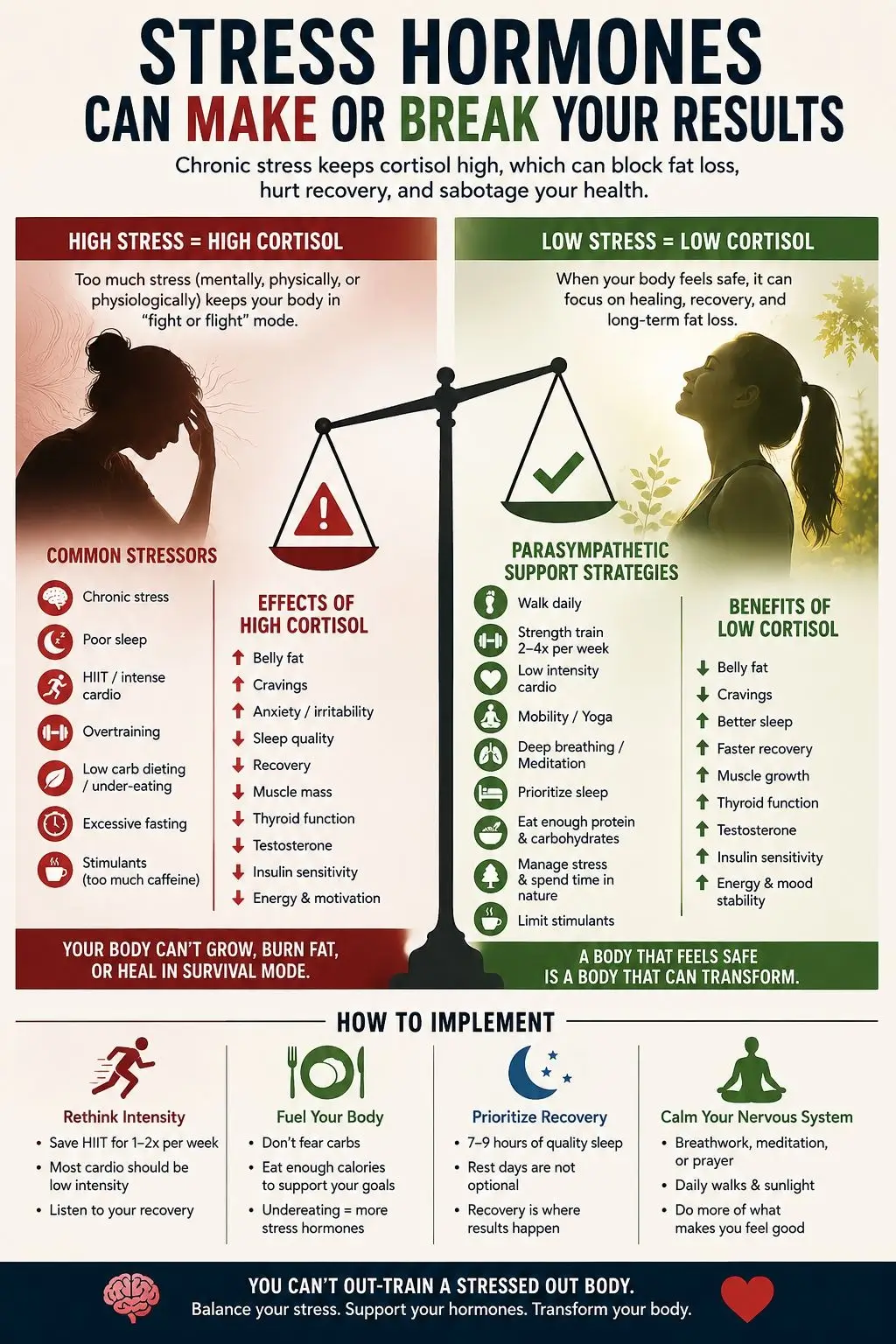
Why More Stress Is Not the Answer for Fat Loss
If fat loss has stalled and your body feels run down, adding more intensity is not always the right move. In many cases, better results come from lowering your overall stress load, improving recovery, strength training consistently, sleeping better, and eating enough to support the work you are asking your body to do.
That matters because the body does not respond only to calories. It also responds to total stress. Training stress, poor sleep, emotional stress, under-eating, long workdays, and constant stimulation can all affect energy, recovery, appetite, and consistency. For many adults in Miami Shores and nearby neighborhoods, that is the missing piece.
The Fitness Industry Often Tries to Solve a Stress Problem With More Stress
A common mistake in fat-loss coaching is assuming that if progress slows down, the answer must be more output:
- More HIIT
- More running
- More fasting
- More food restriction
- More stimulants
- More punishment-based workouts
Sometimes that works briefly. Then the body starts pushing back.
- Energy drops.
- Sleep gets worse.
- Cravings rise.
- Workouts feel flat.
- Recovery slows down.
- Motivation becomes harder to sustain.
This is where many people feel stuck. They are working hard, but their body is clearly not recovering well enough to keep progressing.
Your Body Responds to Total Stress Load
The body does not neatly separate every kind of stress into its own box. Instead, it responds to the total load.
That load can include:
- Emotional stress
- Financial stress
- Inconsistent sleep
- Relationship stress
- Aggressive dieting
- Overtraining
- Too much high-intensity cardio
- Under-fueling for your activity level
Not all stress is bad. Exercise itself is a form of stress, and in the right dose it helps you get stronger and healthier. The problem is when stress stays high and recovery stays low for too long.
Cortisol Is Not the Villain, But Chronic Stress Is a Problem
Cortisol is often talked about like it is automatically harmful. That is not accurate.
Cortisol is a normal hormone that helps regulate energy, alertness, and the stress response. In the short term, it is useful. It helps your body respond to training, wake up in the morning, and handle challenges.
The issue is not cortisol existing. The issue is when someone stays in a chronically stressed, under-recovered state for too long.
When that happens, people often notice patterns like:
- Poor recovery between workouts
- Low energy
- Worse sleep
- More cravings
- Water retention
- Reduced training performance
- Mood swings or irritability
- Feeling wired but tired
- Difficulty staying consistent
That does not mean every fat-loss plateau is a cortisol problem. It does mean that chronic stress can make progress harder, especially when recovery habits are poor.
Why Extreme Dieting and Constant Cardio Often Backfire
Many people lose weight quickly on aggressive plans. That can create the illusion that the plan is working perfectly.
But if the strategy depends on constant restriction, poor recovery, and unsustainably hard training, the rebound is often built in.
This is especially common when people combine:
- Very low calories
- Heavy reliance on stimulants
- Excessive cardio
- Poor sleep
- Minimal strength training
- Chronic low carbohydrate intake despite regular exercise
Over time, that combination can make people feel depleted instead of strong. The scale may move for a while, but the process becomes harder to maintain.
Chronic Low-Carb Dieting Is Not Always a Good Fit for Active Adults
Low-carb diets are not automatically bad. Some people do well with them in certain situations.
But many active adults do not feel their best when carbohydrates stay too low for too long, especially if they are strength training, walking regularly, and trying to maintain muscle while losing fat.
Carbohydrates are the body’s most efficient quick fuel source for higher-intensity activity. When intake stays too low for the amount of work someone is doing, they often report:
- Low training output
- Poor recovery
- Feeling flat in the gym
- Mood changes
- Fatigue
- Feeling cold
- More food preoccupation
That does not mean everyone needs a high-carb diet. It means carb intake should match the person, the goal, and the activity level. For fat loss, the best plan is rarely the most extreme one.
A Body That Never Feels Recovered Usually Does Not Perform Well
If your system constantly feels under pressure, it becomes harder to train well, recover well, sleep well, and stay consistent.
That matters because consistency is what actually drives results.
For many busy professionals, parents, and adults over 30 in Miami Shores, El Portal, Biscayne Park, and North Miami, the real issue is not laziness. It is overload. Long workdays, traffic, family demands, poor sleep, and all-or-nothing training habits create a setup where the body never gets a real chance to recover.
When recovery improves, people often notice better workouts, steadier energy, better decision-making around food, and more sustainable fat-loss progress.
What to Do Instead: Create a More Recovery-Supportive Plan
The answer is not to stop training. The answer is to train intelligently and recover on purpose.
For most adults, a better fat-loss and performance plan includes:
- Strength training 2 to 4 times per week
- Walking daily
- Lower-intensity cardio when appropriate
- Mobility work
- Better sleep habits
- Enough protein to support muscle retention
- Enough carbohydrates to support training and recovery
- Fewer punishment-based workouts
- Better spacing between hard sessions
- Less dependence on stimulants to get through the day
This kind of plan helps signal safety, stability, and recovery. In practical terms, that often means better adherence, better energy, and better body composition over time.
Sometimes the Smartest Move Is to Calm the System Down
Not every workout needs to feel like a test of survival.
Some of the most productive things you can do for fat loss and long-term health are not flashy:
- Go for a walk
- Get to bed earlier
- Lift with good form and stop chasing exhaustion
- Fuel your workouts better
- Take recovery days seriously
- Build a plan you can actually sustain
That is not lazy. That is smart coaching.
At Primal Fit Miami, we want clients to get leaner and healthier, but also stronger, more capable, and more resilient. If your current plan is leaving you drained, your body may not need more punishment. It may need a better balance between stress and recovery.
Yes, chronic stress can affect sleep, appetite, recovery, training quality, and daily habits, all of which can make fat loss more difficult. It is usually not one single hormone issue, but the total picture matters.
No. Cortisol is a normal and necessary hormone. The concern is not cortisol itself, but staying chronically stressed and under-recovered for long periods.
It can if it reduces recovery, increases fatigue, or replaces strength training and sustainable habits. Cardio can be useful, but more is not always better.
Not necessarily. Many active adults perform and recover better with carbohydrate intake that matches their training and lifestyle. The right amount depends on the person.
For many people, a balanced plan works best: strength training, walking, mobility work, and enough recovery between hard sessions. The best plan is one you can maintain consistently.